
A practical guide to creating consistency, improving staff performance, and delivering better guest experiences
Author: Wisdom Emori
Introduction
A hotel can have beautiful rooms, modern facilities, professional furniture, and an impressive reception area, but none of these things can guarantee consistent service.
Guests expect more than a beautiful property. They expect staff to know what to do, how to respond, how to handle requests, and how to solve problems professionally.
This is where hotel standard operating procedures (SOPs) become important.
Hotel SOPs provide clear instructions for how different tasks and services should be performed. They help employees understand their responsibilities and ensure that important procedures are followed consistently across departments and shifts.
For Nigerian hotels, service apartments, boutique hotels, and premium hospitality businesses, having proper SOPs can improve service delivery, reduce operational mistakes, strengthen staff accountability, and create a more reliable guest experience.
At Ivan JA Mega Limited, we believe that premium hospitality is built through people, systems, discipline, training, and consistent service delivery. SOPs are an important part of creating that structure.
What Are Hotel SOPs?
Hotel SOPs are Standard Operating Procedures that explain how specific tasks and services should be carried out within a hotel.
They provide employees with clear instructions instead of leaving important decisions entirely to individual judgement.
For example, a hotel may have an SOP explaining:
How guests should be welcomed at reception
How reservations should be confirmed
How rooms should be inspected before check-in
How housekeeping should prepare a room
How room service orders should be handled
How guest complaints should be escalated
How security staff should manage visitors
How maintenance problems should be reported
How check-in and checkout should be completed
How staff should communicate with guests
A good SOP should be practical, easy to understand, and relevant to the actual operation of the hotel.
It should not simply be a document kept in an office. Staff should understand it, receive training on it, and use it as part of their daily responsibilities.
Why Are Hotel SOPs Important?
A hotel operates through many departments, employees, shifts, and daily interactions with guests.
Without clear procedures, service quality can become inconsistent.
One employee may handle a situation professionally while another may respond differently. One shift may maintain excellent standards while another shift may overlook important details.
SOPs help reduce this inconsistency.
1. SOPs Create Consistency
Guests want to know what to expect.
If a hotel provides excellent service on Monday but poor service on Tuesday, the guest does not experience a consistent brand.
SOPs establish a common standard that employees are expected to follow.
The front desk team should know how guests are welcomed. Housekeeping should understand how rooms are prepared. Restaurant staff should understand how orders are handled. Security should know how visitors are managed.
Consistency helps create trust.
This is one of the reasons five-star hospitality standards depend heavily on documented systems and operational discipline.
2. SOPs Improve Staff Accountability
When responsibilities are clearly documented, it becomes easier for managers to understand who is responsible for each task.
Employees also have a clearer understanding of what is expected from them.
If a particular procedure is not followed, management can identify the problem and provide the necessary correction or training.
SOPs therefore help create a stronger culture of accountability.
3. SOPs Reduce Operational Mistakes
Mistakes can happen in any hotel.
A reservation may be entered incorrectly. A room may not be properly inspected. A guest request may be forgotten. A maintenance problem may not be reported.
Clear procedures reduce the possibility of these mistakes by giving staff a defined process to follow.
The objective is not to eliminate every possible mistake. It is to create systems that make important tasks easier to perform correctly.
4. SOPs Make Staff Training Easier
Training becomes more effective when employees have clear procedures to learn.
Instead of simply telling a new employee to "serve guests professionally," the hotel can provide specific standards for greeting guests, handling complaints, communicating by phone, processing requests, and completing departmental tasks.
This is why SOP development and hotel staff training should work together.
Training teaches employees how to perform their responsibilities, while SOPs provide the structure they are expected to follow.
5. SOPs Improve Management Control
Managers cannot personally supervise every employee and every task throughout the day.
A well-designed SOP system gives management a framework for monitoring operations.
Managers can use procedures, checklists, reports, and service standards to determine whether departments are operating as expected.
This allows management to focus not only on solving problems but also on preventing them.
Which Areas of a Hotel Need SOPs?
Every major department can benefit from documented procedures.
A hotel does not need to create one document and consider the job finished. Different departments require different procedures based on their responsibilities.
Front Desk and Reception SOPs
The front desk is one of the most important departments because it interacts directly with guests.
Front desk SOPs can cover:
Guest greetings
Reservation confirmation
Check-in procedures
Check-out procedures
Payment handling
Telephone etiquette
WhatsApp communication
Guest identification and privacy
Room assignment
Guest requests
Complaint escalation
Lost and found procedures
The objective is to make the guest journey smooth and professional.
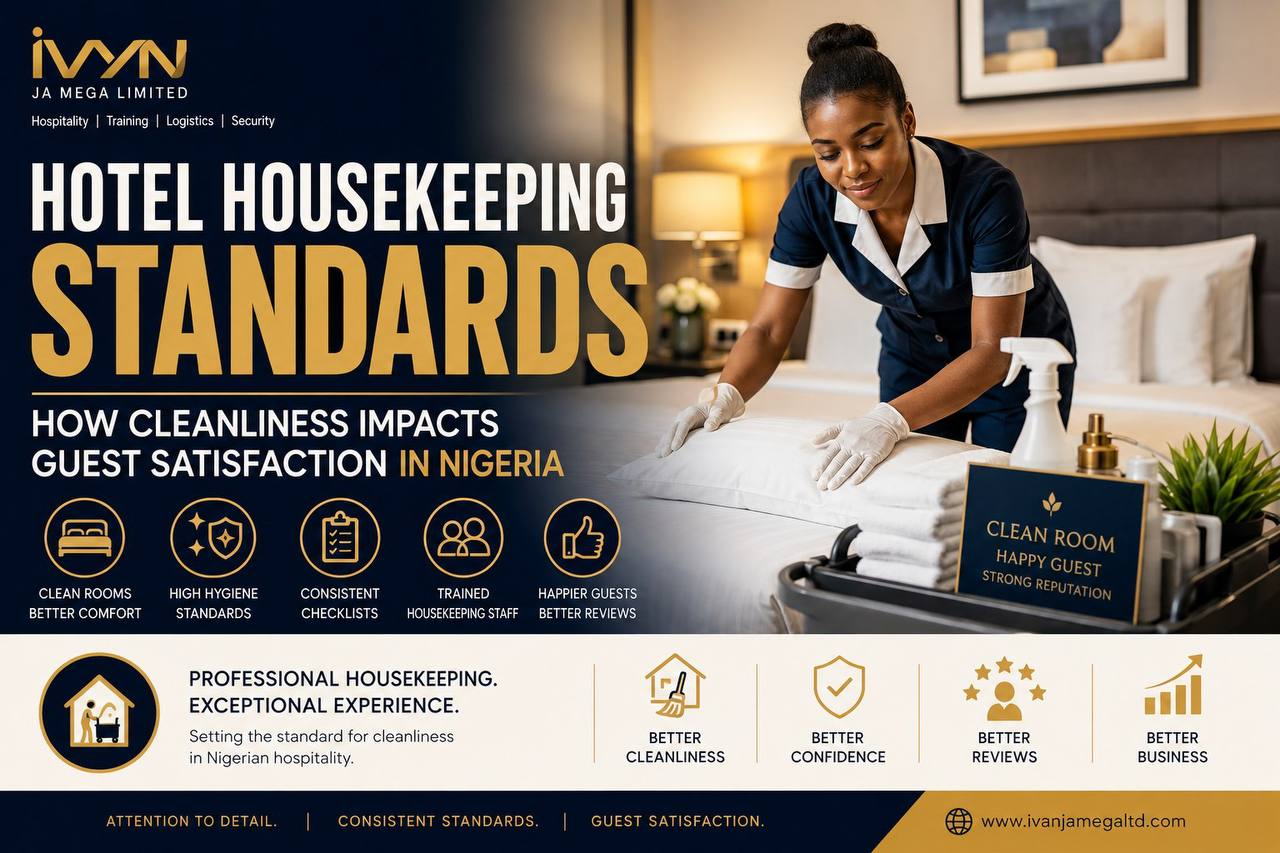
Housekeeping SOPs
Housekeeping has a direct effect on how guests perceive the hotel.
Housekeeping SOPs can cover:
Room cleaning procedures
Bathroom cleaning
Bed preparation
Towel replacement
Room inspection
Cleaning supplies
Guest privacy
Handling guest belongings
Reporting maintenance problems
Lost and found procedures
Final room checks
A room should not simply be cleaned. It should be prepared according to a defined standard.
Restaurant and Food Service SOPs
Food and beverage operations also require clear procedures.
Restaurant SOPs can cover:
Guest greeting
Table preparation
Menu presentation
Order taking
Order confirmation
Food presentation
Hygiene standards
Room service
Handling special requests
Complaint handling
Table clearing
Closing procedures
Good food service depends not only on the quality of the food but also on timing, hygiene, communication, and professionalism.
Security SOPs
Hotel security requires professionalism because guests should feel protected without feeling uncomfortable.
Security SOPs can cover:
Property access control
Visitor management
Parking management
Guest privacy
Emergency response
Incident reporting
VIP guest handling
Security communication
Access to restricted areas
Coordination with hotel management
For premium guests, executives, expatriates, and high-profile visitors, logistics and security can also become an important part of the overall hospitality experience.
Maintenance SOPs
A beautiful hotel can quickly lose its premium image when basic facilities stop working.
Maintenance SOPs can establish procedures for:
Reporting faults
Inspecting equipment
Air-conditioning maintenance
Plumbing issues
Electrical problems
Water systems
Generator and power systems
Preventive maintenance
Emergency repairs
Maintenance reporting
Preventive procedures are particularly important because fixing a problem before it affects guests is often better than waiting for a guest complaint.
Hotel SOPs and Staff Training
SOPs and staff training should not be treated as separate activities.
A hotel may have excellent procedures written in a manual, but those procedures are of limited value if employees do not understand them.
Staff must be trained on the procedures relevant to their departments.
For example, a front desk employee should understand the hotel's check-in procedure. A housekeeper should understand the room inspection process. A restaurant employee should understand the hotel's service standards.
Training also gives employees the opportunity to ask questions, practice procedures, receive feedback, and understand why certain standards matter.
This is why professional hospitality training should include both practical instruction and clear operational procedures.
When SOPs and training work together, employees have greater clarity and confidence.
How Hotel SOPs Improve the Guest Experience
The ultimate purpose of hotel SOPs is not paperwork.
It is better service.
Guests may never see an SOP manual, but they experience the results of good procedures through the service they receive.
Faster Response to Guest Requests
When employees know who is responsible for a task and what steps to follow, requests can be handled more efficiently.
This can reduce unnecessary delays and confusion.
Better Communication
SOPs can establish communication standards between departments.
For example, when housekeeping discovers a maintenance issue, there should be a clear process for reporting it to the appropriate department.
Good communication prevents small problems from becoming larger guest complaints.
Better Complaint Handling
Complaints require a structured response.
Staff should know how to listen, document the issue, apologize appropriately, escalate when necessary, provide practical solutions, and follow up.
A clear complaint-handling SOP can help employees respond professionally instead of reacting emotionally or inconsistently.
More Consistent Service
A guest should not receive excellent service only when a particular manager or experienced employee is working.
The system should help the entire team maintain the same standard.
That is one of the strongest benefits of proper SOP implementation.
Common Problems Nigerian Hotels Face Without SOPs
Many operational problems can become more difficult when there are no clear procedures.
Common examples include:
Different service standards between shifts
Poor communication between departments
Staff depending too heavily on personal experience
Repeated guest complaints
Slow response to guest requests
Poor housekeeping consistency
Confusion during busy periods
Managers constantly solving routine problems
Difficulty training new employees
Important tasks being forgotten
Weak accountability
Inconsistent complaint handling
Another major problem is the loss of knowledge when experienced employees leave.
If important procedures exist only in an employee's memory, the hotel may struggle when that employee resigns.
Documented SOPs help preserve operational knowledge and make it easier to train replacements.
What Should a Hotel SOP Manual Contain?
A professional hotel SOP manual should be organized according to the hotel's departments and operations.
Depending on the property, it may include:
Department responsibilities
Job procedures
Service standards
Guest communication standards
Checklists
Reporting procedures
Complaint escalation procedures
Emergency procedures
Hygiene standards
Grooming standards
Guest privacy requirements
Maintenance reporting
Security procedures
Performance expectations
Management approval processes
The manual should also be written in a way that employees can actually understand and use.
Overly complicated procedures can create another problem.
The best SOP is one that is clear, practical, measurable, and easy for employees to follow.
How Hotel Owners Can Implement SOPs
Creating SOPs does not have to happen overnight.
Hotel owners and managers can begin by examining how the property currently operates.
Step 1: Review Current Operations
Identify the major departments and document how important tasks are currently performed.
Ask questions such as:
How are guests welcomed?
How are complaints handled?
How are rooms inspected?
How are maintenance issues reported?
How are guest requests communicated?
What happens when an employee is absent?
Step 2: Identify Recurring Problems
Look at guest complaints, staff mistakes, operational delays, and areas where managers constantly have to intervene.
These problems can reveal where stronger procedures are needed.
Step 3: Document the Procedures
Create clear step-by-step procedures for important tasks.
The procedures should reflect the actual hotel operation rather than simply copying generic instructions.
Step 4: Train the Staff
Employees must understand the procedures and know how to apply them.
Training should include practical examples, demonstrations, questions, and supervision.
Step 5: Monitor Compliance
Management should regularly check whether procedures are being followed.
This can be done through inspections, checklists, guest feedback, service audits, and departmental supervision.
Step 6: Review and Improve
Hotels change over time.
New technology, new staff, new guest expectations, new facilities, and operational changes may require SOPs to be updated.
An SOP manual should therefore be treated as a working management tool rather than a document that is written once and forgotten.
SOPs, Five-Star Standards and Long-Term Hotel Success
A five-star hotel is not created by expensive furniture alone.
It requires a combination of professional people, strong systems, excellent service, cleanliness, security, maintenance, and consistency.
SOPs help connect these areas.
Staff training gives employees the knowledge and skills they need.
SOPs give them a clear operational framework.
Management provides supervision and accountability.
Together, these elements help create a more reliable guest experience.
As discussed in our guide to what makes a hotel five-star, premium hospitality depends heavily on consistency. Guests should receive professional service whether they arrive on a busy weekend, during a quiet weekday, or when a particular manager is not present.
That level of consistency requires systems.
How Ivan JA Mega Limited Supports Hotel Operations
Ivan JA Mega Limited supports hospitality businesses that want to improve their service standards, staff performance, and operational structure.
Through Five-Star Service Training, SOP development, service standards, guest experience systems, and operational support, Ivan JA Mega Limited helps hospitality businesses create stronger structures for consistent service delivery.
The company also supports hotels and service apartments with professional hospitality solutions designed around guest experience, operational performance, and service quality.
The objective is not simply to create procedures for the sake of having manuals.
The goal is to help hotels build systems that employees can understand, management can monitor, and guests can experience through better service.
For hotels that want to improve their operations, strengthen staff performance, reduce service inconsistencies, and build a more professional hospitality brand, proper SOP development is an important place to start.
Final Thoughts
Hotel SOPs are not unnecessary paperwork.
They are an important part of professional hotel management.
A hotel may have talented employees, beautiful rooms, and excellent facilities, but without clear systems, service quality can become inconsistent.
Proper Standard Operating Procedures help employees understand their responsibilities, improve accountability, reduce mistakes, support staff training, strengthen communication, and create more consistent guest experiences.
For Nigerian hotels, service apartments, boutique hotels, and premium hospitality businesses, investing in SOPs can help create the structure required for sustainable service excellence.
Training teaches people how to serve.
SOPs help define how the service should be delivered.
Management ensures that the standard is maintained.
When these three elements work together, a hotel is better positioned to deliver the professional, consistent, and memorable experience that guests expect.
For hotels, service apartments, and hospitality businesses that want to improve their operational standards, Ivan JA Mega Limited provides hospitality training, SOP development, hotel management support, logistics, and guest experience solutions designed for premium service delivery.
Frequently Asked Questions
What are hotel SOPs?
Hotel SOPs are Standard Operating Procedures that provide clear instructions for how specific tasks and services should be performed within a hotel. They help employees follow consistent procedures and maintain service standards.
Why are SOPs important in hotels?
SOPs help hotels create consistency, reduce operational mistakes, improve staff accountability, support training, strengthen communication, and provide a more reliable guest experience.
What should a hotel SOP manual contain?
A hotel SOP manual can contain departmental responsibilities, service procedures, checklists, communication standards, complaint-handling procedures, emergency processes, guest privacy requirements, maintenance procedures, security standards, and performance expectations.
How do SOPs improve guest experience?
SOPs help employees understand how to respond to guest requests, handle complaints, communicate with other departments, and perform important tasks consistently. This can lead to faster responses and more reliable service.
Do small hotels need SOPs?
Yes. SOPs are useful for hotels of different sizes because even smaller properties need clear procedures for guest service, housekeeping, maintenance, security, reservations, and other daily operations.
How often should hotel SOPs be updated?
Hotel SOPs should be reviewed regularly and whenever there are significant changes to staff responsibilities, facilities, technology, guest expectations, or operational procedures.
Can Ivan JA Mega Limited help hotels develop SOPs?
Yes. Ivan JA Mega Limited supports hospitality businesses with service training, SOP development, guest experience systems, operational support, and other hospitality solutions designed to improve service delivery.